



About This Plugin
WordPress MCP server for AI agents, governed and off by default
Agent Abilities for MCP is a WordPress plugin that turns your site into a governed Model Context Protocol (MCP) server. It exposes 153 curated WordPress “abilities” (tools) to AI agents like Claude, Cursor, and VS Code over MCP, so your AI client can read and, when you allow it, write to your site as a real, least-privilege WordPress user you choose. It is built on the WordPress 6.9 Abilities API and the official MCP Adapter, so there is no custom server or transport to trust.
Nothing is exposed until you turn it on. The agent only ever acts as the WordPress user you bind it to, never an admin-equivalent key, and every call is re-checked against that user’s capabilities and logged before it runs, denials included. You add reach as you build trust, not all at once. Your own AI client connects in to your site; the plugin makes zero outbound calls and has no telemetry.
Prefer to watch first? Here is a short walkthrough of the plugin in action.
Quick links: Documentation | Getting started | Supported clients | GitHub
🛡️ Least-privilege access by design
- Least privilege by design. The AI agent connects as a real, scoped WordPress user through OAuth or an Application Password, never an admin-equivalent key.
- Off by default. Nothing is exposed until you enable it, and updates never silently widen access.
- Two-layer capability gating. A connection only sees the tools its user can call, and every call re-checks that capability before it runs.
- Honest audit log. Every call is recorded, denied attempts included, with the principal and the argument keys (never the values). It lives in your own database and clears from the admin.
- Bounded by construction. No arbitrary option or meta access, no remote URL fetch, no code execution. Uploads are decoded from inline data and checked by their real bytes against an image allow-list, never fetched from a URL. A created user gets the site default role, never admin, and the last administrator can never be removed. Anything destructive is off by default and capability-gated, and deletes go to Trash where the ability supports it.
- Optional safety controls. Switch on a per-minute rate limit, an IP allowlist, a force-to-draft mode, or a title-length cap. All four stay off until you set them.
- No data leaves your site. The plugin contacts no AI provider and no external service. Your AI client connects in; the plugin never reaches out.
- Two ways to connect. Approve an agent in the browser over OAuth, with no secret to store, or point a dedicated low-privilege user at an Application Password. A guided screen builds the client config and checks the endpoint for you.
🤖 Built on the WordPress Abilities API and MCP Adapter
WordPress 6.9 ships the Abilities API and the official MCP Adapter. Agent Abilities for MCP registers a curated, governed set of abilities on top of them rather than inventing its own protocol or transport. It builds on the official MCP Adapter library (wordpress/mcp-adapter) rather than a custom server, so there is no bespoke server to trust and the plugin inherits the standard’s behavior. What it adds is the governance layer: the off-by-default catalog, the capability gating, the safety controls, and the audit log for running the Model Context Protocol on WordPress.
📦 153 governed abilities
The plugin ships 153 governed abilities: 83 across WordPress core and 70 from auto-detected integrations. Every one is off until you enable it, scoped to the bound user, capability-gated, and logged. Beyond these, it can also bridge abilities declared by your other plugins (see below).
WordPress core (83 abilities). Reads plus guarded writes across your whole site:
- 📝 Posts & Pages: list, read, create, update, and delete posts and pages, with destructive actions off by default and deletes routed to Trash.
- 🏷️ Terms & Taxonomies: manage categories, tags, and custom taxonomy terms.
- 💬 Comments: read and moderate the comment queue.
- 🖼️ Media: list and read the media library, and add images decoded from inline data and validated by their real bytes against an image allow-list (never fetched from a URL).
- 🗂️ Post Meta: read and write only the meta keys an administrator has explicitly allowlisted. Protected, underscore-prefixed, and authentication keys can never be allowlisted.
- 👥 Users: read and manage users within capability limits. A new user gets the site default role, never admin, and the last administrator can never be removed.
- 🧭 Site structure: work with menus and the structural pieces that hold the site together.
- 🕓 Revision history: read the revision trail for content.
- 🧱 Blocks & Templates: work with reusable blocks, themes, and templates.
- ⚙️ Limited settings & site health: a tightly scoped set of settings, plus read-only site health and plugin status.
- 🔍 Site-wide search: one search that spans every post type at once.
Integrations (70 abilities). Detected automatically per active plugin, off until you turn them on, capability-gated, and logged. Each appears only while its host plugin is active:
- 🛒 WooCommerce MCP (52 abilities): read and write products, orders, and customers so an AI agent can help run your store. These touch real customer and order data, including personal data such as names, emails, and addresses, so they sit behind a clear admin notice and stay off until you switch them on.
- 🧩 Advanced Custom Fields (7 abilities): read and write ACF field data. Like WooCommerce, these can reach real personal data and sit behind the same clear notice.
- 📈 Rank Math SEO (5 abilities): read and manage Rank Math SEO data.
- 📈 Yoast SEO (3 abilities): read and manage Yoast SEO data.
- 📈 All in One SEO (3 abilities): read and manage AIOSEO data.
More integrations are planned.
🔗 Abilities from your other plugins (new in 1.1.0)
WordPress 6.9 lets any plugin register its own abilities, not just this one. Agent Abilities for MCP can now bring those in too. When another active plugin declares abilities through the Abilities API, they appear on a dedicated Abilities from other plugins screen, grouped by the plugin that registered them, every one off until you turn it on. Enable one and it becomes a governed MCP tool under the same rules as the built-in catalog: scoped to the bound user, capability-checked on every call, rate-limited, and written to the same audit log. Argument values are still never stored.
So you are not limited to the integrations shipped here. Any plugin that speaks the Abilities API can be handed to your agent on your terms, and you can flip a whole plugin’s set on or off at once. For fleets or record-keeping, the bundled WP-CLI command wp aafm catalog export prints a site’s discoverable abilities as JSON.
🔌 Supported AI platforms
Your AI client connects in to your site over MCP. The plugin never calls out to any AI provider, so there is no model API key to add and nothing extra to pay for.
- Anthropic Claude: works today. The claude.ai web app and Claude Desktop share one custom-connector flow, so you paste your endpoint URL and approve the sign-in once. Claude Code connects from the command line.
- OpenAI ChatGPT: works once you turn on developer mode in ChatGPT and add your site as a custom connector.
- Manus: works by adding your endpoint as a custom MCP connector and approving the sign-in. Manus runs in the cloud, so it connects by URL with no local bridge.
- Google Gemini: works today through the Gemini CLI.
- Any Model Context Protocol client: anything that speaks MCP can connect, directly or through the open-source
mcp-remotebridge that runs on your own machine.
The hosted Gemini app is not supported yet. The clients listed below all work today.
🧩 Compatible clients and frameworks
Connect any MCP client that can reach your site’s endpoint. With OAuth you paste the endpoint URL and approve once in the browser; with an Application Password you point a dedicated low-privilege user at the endpoint.
- Hosted cloud apps: ChatGPT (developer mode turned on, your site added as a custom connector), Claude (the claude.ai web app and Claude Desktop, which share one connector flow), and Manus. These connect by URL over OAuth, so there is no config file to edit and no bridge to install.
- AI code editors and IDEs: Claude Code, Cursor, VS Code, and Windsurf.
- Command line: Gemini CLI.
- AI agent frameworks: any MCP-compatible framework can call your enabled abilities as tools.
- Bridged clients: clients that cannot open a remote MCP connection on their own use the open-source
mcp-remoteor@automattic/mcp-wordpress-remotebridge, which runs on your own machine and talks only to your site and your local client.
⚖️ Disclaimer
Model Context Protocol (MCP) is an open specification originally developed by Anthropic. Claude, ChatGPT, Cursor, VS Code, Gemini, and other product names are trademarks of their respective owners. Agent Abilities for MCP is a third-party plugin and is not affiliated with, endorsed by, or sponsored by any of them.
External Services
This plugin does not contact any external service. It registers abilities on your own site and answers the requests your AI client sends to it. It makes no outbound requests of its own and includes no analytics or telemetry.
Connecting an AI client to your site is done by the client, not by this plugin. Some MCP clients reach your endpoint directly; others use a small bridge program that runs on your own computer, such as the open-source mcp-remote tool or @automattic/mcp-wordpress-remote. Neither bridge is bundled with this plugin or run by it. You install and run it yourself, and it talks only to your site and your local AI client. Their terms are on their own pages:
- mcp-remote: https://www.npmjs.com/package/mcp-remote
- @automattic/mcp-wordpress-remote: https://www.npmjs.com/package/@automattic/mcp-wordpress-remote
Screenshots
 The first run walks you through connecting an agent in three steps. Turn the connection on, choose what it can touch, then hand the endpoint to your AI client.
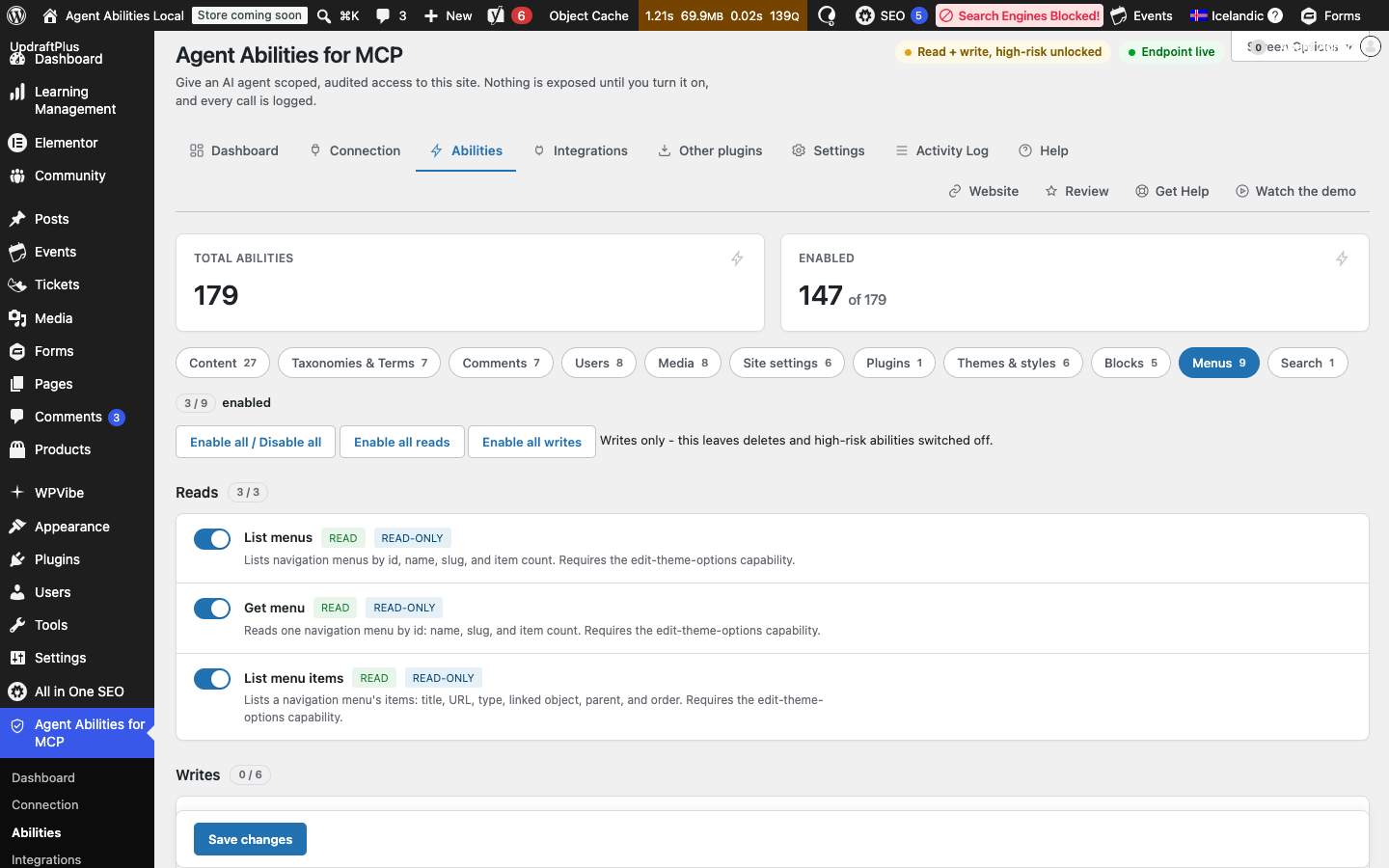 Nothing is exposed until you switch it on. Three of this site's 179 abilities are enabled here, all of them reads, using the button that turns on a section's reads and leaves its writes alone.
 Read-only mode in force. Every ability that writes loses its checkbox completely and says which switch is holding it down, so a bulk enable cannot sweep one back in by accident.
 Read-only mode is a single switch on the Settings tab. While it is on, the high-risk category underneath is held as well, and says so instead of sitting there looking live.
 The WooCommerce abilities that move money or grant authority stay padlocked behind a second switch of their own, sitting among ordinary writes you can turn on one at a time.
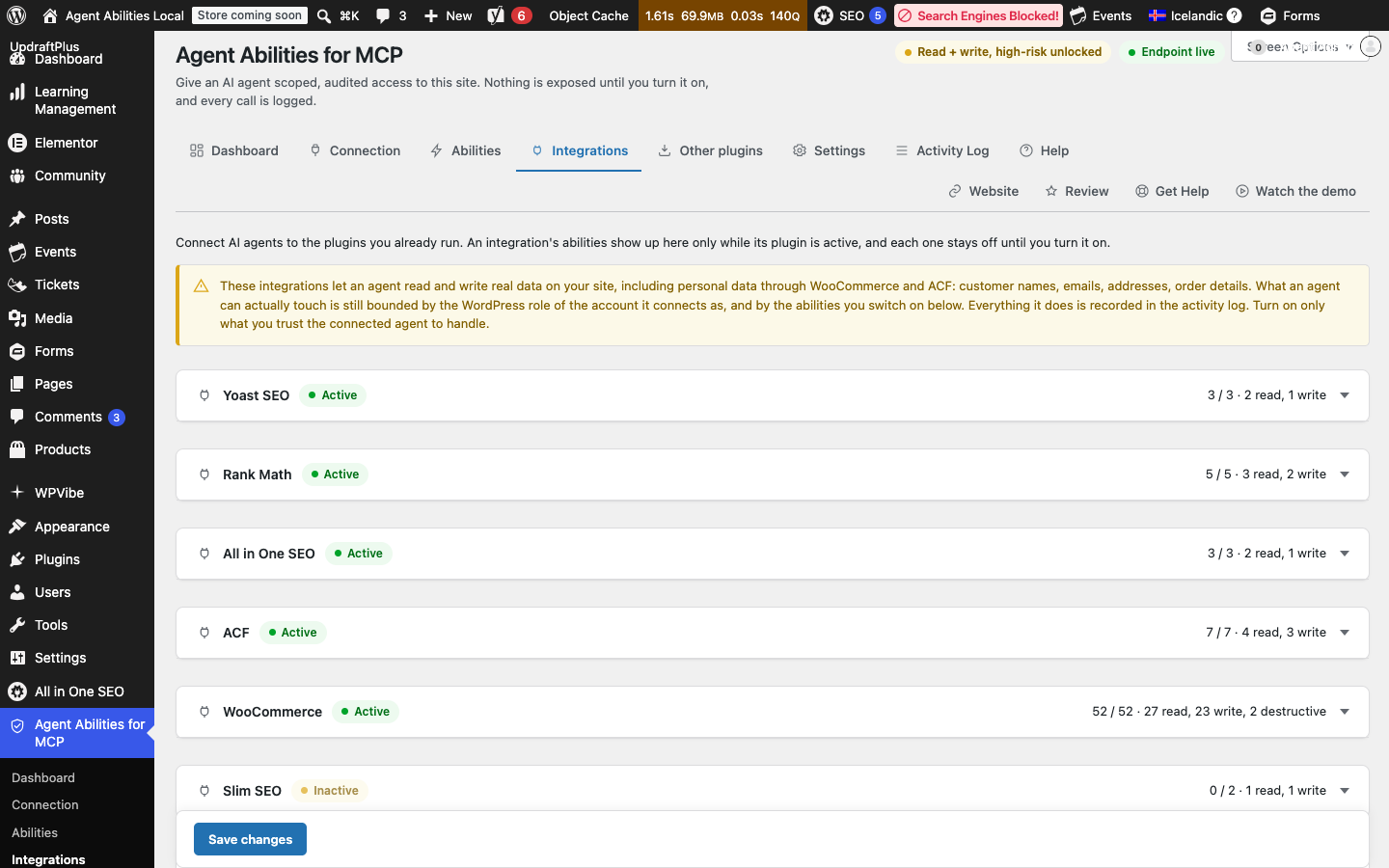 An integration only appears once the plugin it belongs to is active. WooCommerce, Yoast, Rank Math, and All in One SEO are all running here, each with its abilities turned on, while Slim SEO waits for its plugin to be installed.
 Abilities that your other plugins register for themselves, grouped by the plugin that declared them, each one off until you turn it on and labelled with the risk that plugin reports.
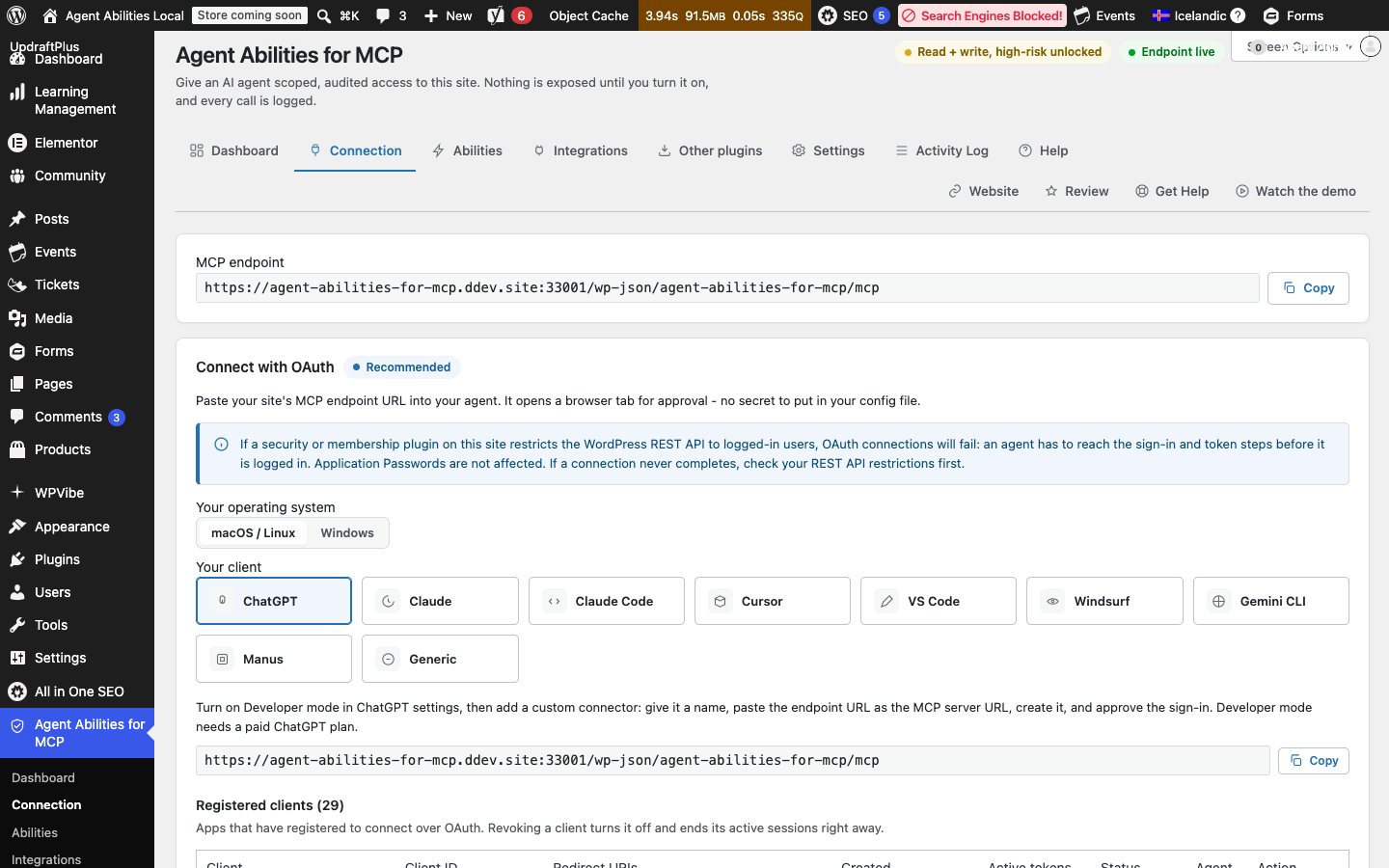 Your MCP endpoint, the OAuth approval flow that leaves no secret in your config file, and a dedicated low-privilege agent user. The Application Password fallback carries a plain warning that it reaches further than this plugin can scope.
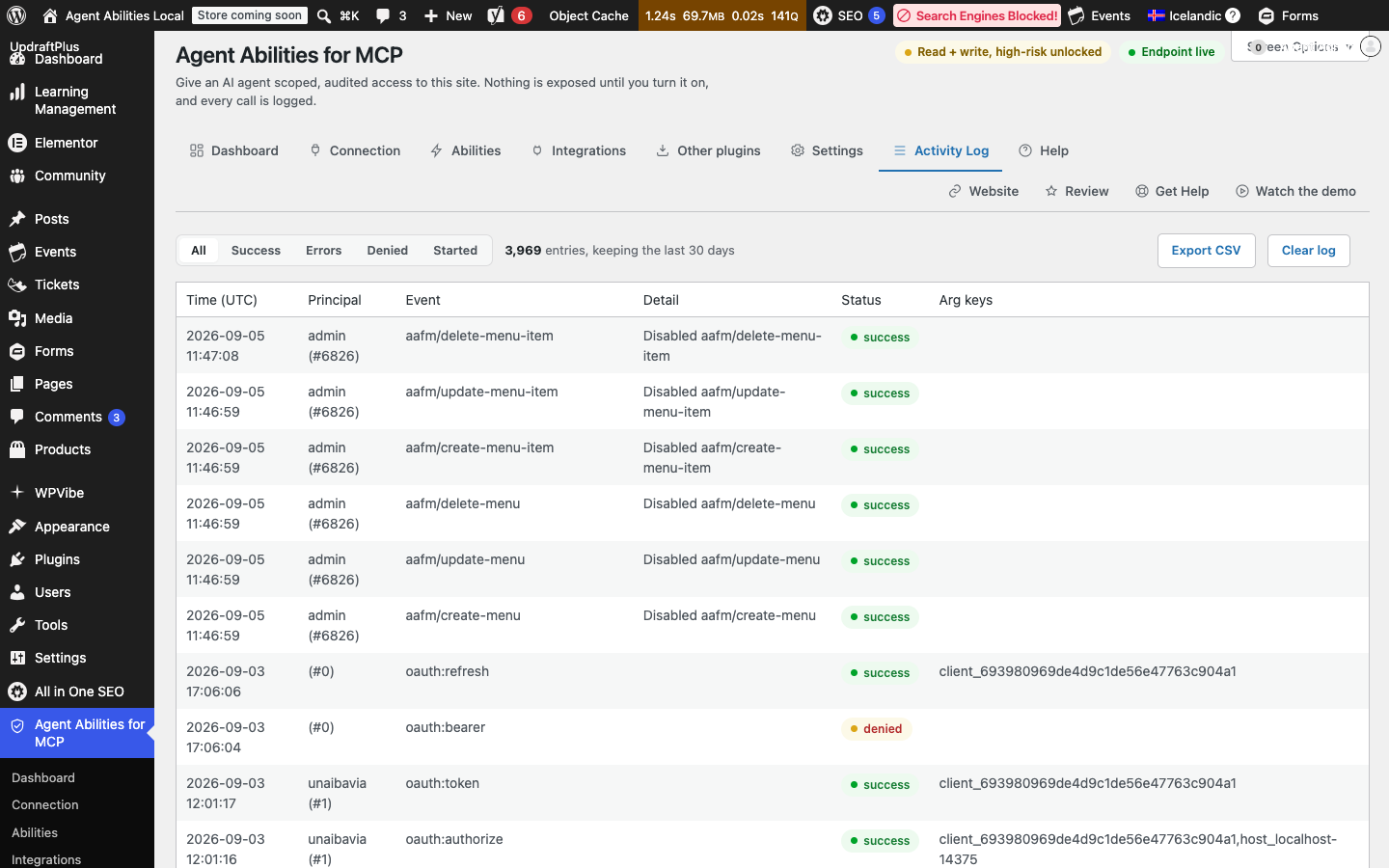 The activity log records what happened and who did it, including every change to what is enabled, with filters for successes, errors, denials and calls that never finished, and a CSV export.
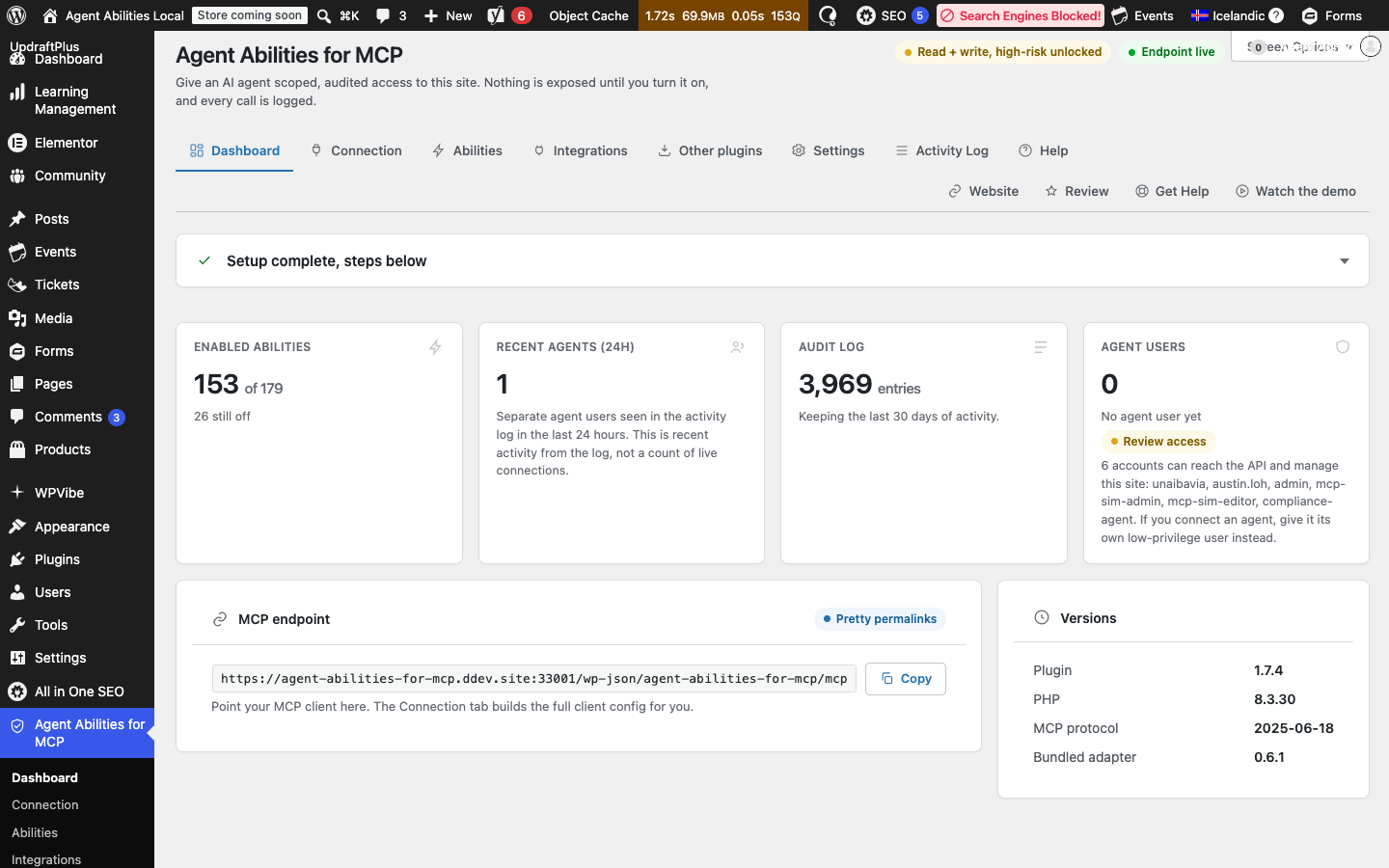 The dashboard tracks setup and shows enabled abilities, recent agents, how much audit history you are keeping, your endpoint, and the versions in play.